
Last week, the Trainline Partner Solutions team joined industry peers at the The BTA Autumn Conference in Munich, one of the business travel industry’s most anticipated gatherings in the calendar.
The event brought together a cross functional group of industry leaders, from TMCs and OBTs, to technology and travel providers.
The theme ‘Let’s get to work’ pinpointed the importance of changing the perception of business travel, exploring how we can work more collaboratively as an industry to provide a best-in-class experience for corporate travellers.
And while many themes were debated across the two days, one stood out above the rest, the transformative potential of AI.
Why is AI on the agenda?
AI isn’t new to travel, but the conversation has shifted. No longer an abstract, future-facing concept, it’s embedded in many of the tools we use daily to travel. AI is already being applied across booking flows, customer experience and corporate travel management.

For an industry navigating sustainability targets, cost pressures, and shifting traveller expectations, AI offers something essential: simplicity, transparency and speed.
At Trainline Partner Solutions, we see this every day. Rail is becoming more liberalised across Europe, with new entrants adding choice but also creating complexity in fares, carriers and licensing. Travellers and corporates alike want seamless journeys across borders. TMCs and OBTs want standardisation. Carriers want distribution that doesn’t dilute their value.
But is AI the right tool that can bring this ecosystem together?
Our key takeaways: The AI and Future of Business Travel Panel
On day two of the conference, General Manager of Trainline Partner Solutions, Andrew Cruttenden joined Joanna Greenfield (BCD Travel) and Alister Harris (Lokulus) to explore how AI is already reshaping corporate travel.
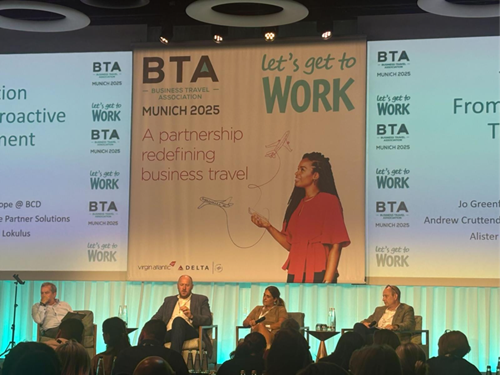
Here are our five takeaways from the discussion we though were worth sharing:
1. Personalising journeys AI is enabling smarter, more relevant travel search throughout the journey planner. For corporate travellers, this means results that better tailored to their needs and journeys that fit seamlessly into busy schedules.
2. Driving efficiency AI is streamlining processes across the workplace. From back-office workflows to expense management, the technology is reducing friction and freeing people to focus on work that’s important for them, and adds value.
3. Empowering travellers to self-serve AI has the potential to help travellers cut through complex fare rules and booking flows, giving them clearer choices and more confidence to self-serve. For TMCs and OBTs, that means fewer offline queries and a smoother, more scalable booking experience.
4. Cutting through complexity European rail liberalisation means corporate travellers have more choice than ever before. But more choice usually means more complexity. Different carriers, fares and rules can make journeys complicated. AI has the potential to cut through the noise bring clarity to longer cross-border journeys.
5. Accelerating competition AI is making it easier for new players to enter the market with smarter tools and simpler booking flows. That means more choice, more pressure to innovate, and ultimately a better experience for corporate travellers. But, it also means companies need to move fast as the next generation of business travellers won’t wait around for them.
What does this mean for business travel?

Corporate travellers increasingly expect intuitive tools that make their journeys more comfortable and seamless. Corporates, meanwhile, need tighter cost control and transparent compliance to stay in-policy and meet ESG targets
Therefore, the industry as a whole is under pressure to reduce complexity while improving the experience. And at Trainline Partner Solutions, that’s at the heart of everything we do.
Our distribution products Global API and Agent Tool carry that same spirit. They simplify Europe’s patchwork of carriers, fares and rules, bringing everything into one consistent flow. Meaning TMCs, OBTs and corporates can offer rail in a way that feels seamless to the corporate traveller.
Looking ahead, AI can accelerate this shift towards seamless travel. By cutting through complexity, surfacing smarter choices and reducing manual processes, it has the potential to make greener, simpler business travel more practical – if used correctly.